
Going to Search Central Live Zürich yesterday was one of those “industry check-ins” you hope will recalibrate your head when things are this crazy!
Between announcements, conversations and a few existential questions, personally it felt like the right reset.
Here’s what stuck with me, what I’m still chewing on, and what might shape how I work going forward.
The right tone from the get go thanks to Martin Splitt
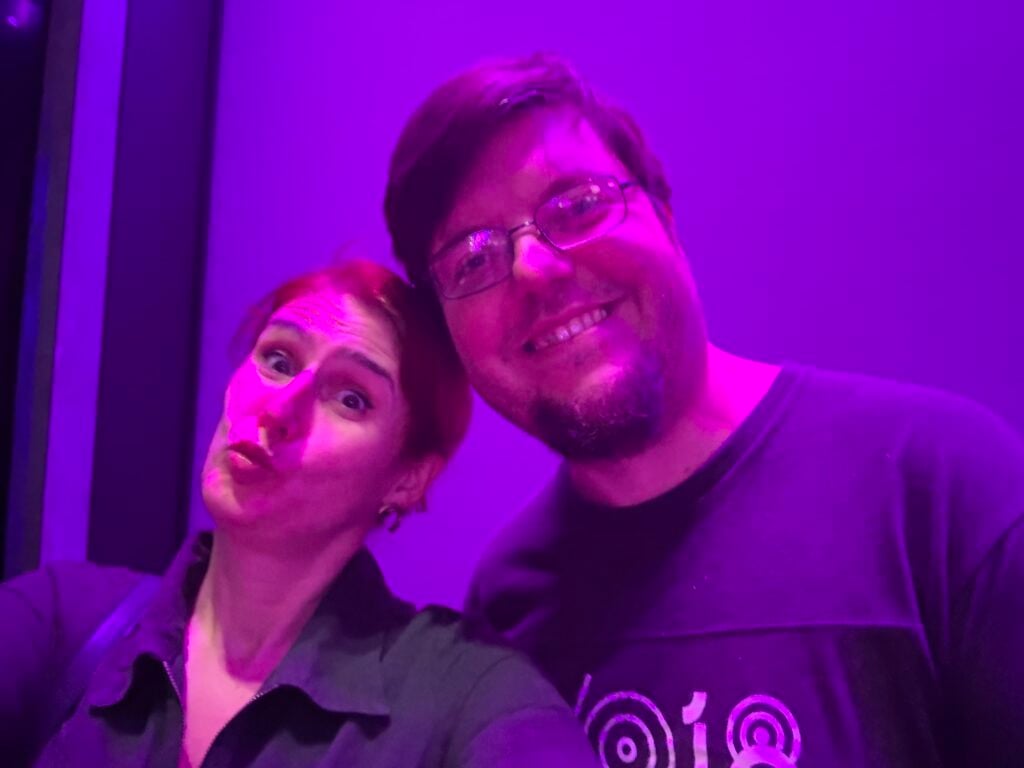
The day opened with a talk by Martin Splitt and who set an honest tone to the meet up. He also found out that people take selfies with John more than him so I felt compelled to help out. You’re welcome.
Instead of hype or sweeping claims, he acknowledged what many of us have felt this year: uncertainty, disruption, constant change.
But he finished with a call for all of us to get the best out of the internet together.
That felt grounding. It reminded me of the bat that we forget Google is a massive company. It is tempting to paint it all black considering the decreasing traffic and the flux we are all in, but there is value in remembering that some really awesome people work at Google.
Just like us, at least those of us not selling snake oil and peeing in the community pool, really believe in building a digital ecosystem we can all be proud of.
But enough of the soppy-ness, let’s move on…
Best session of the day: Pascal Fleury on Structured Data
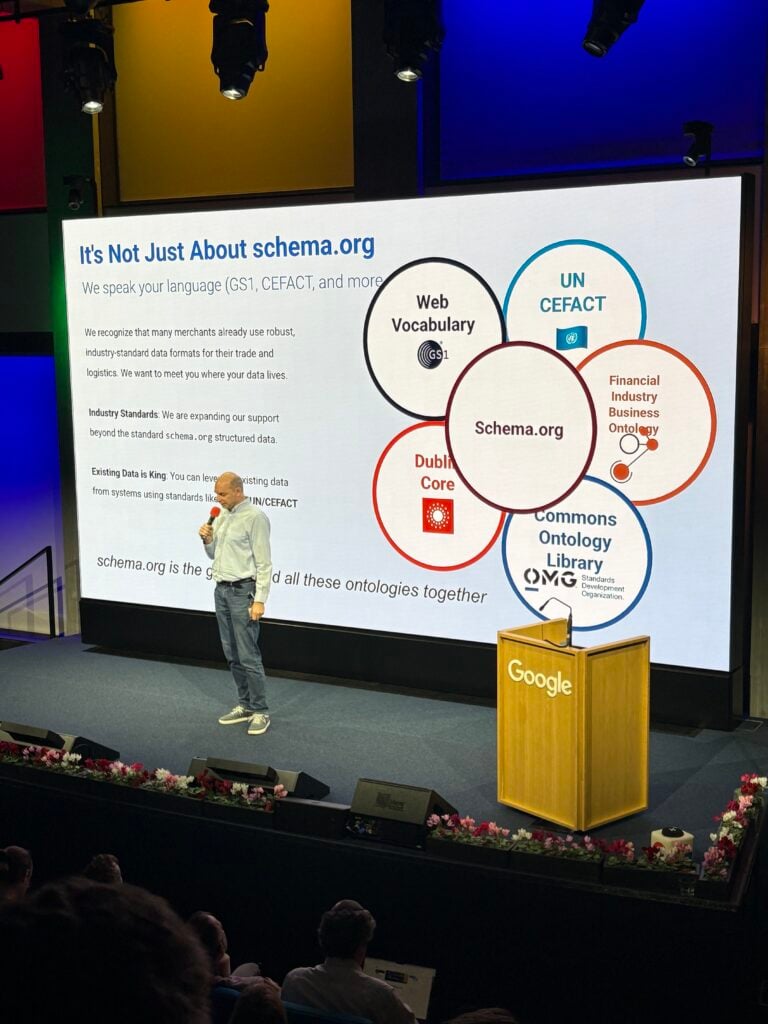
A bit biased here since I love a bit of technical but my favourite session of the day was by far Pascal Fleury’s from Google Shopping. He unpacked structured data in a way that was refreshingly realistic and immensely useful.
Legacy stacks are real.
In Pascal’s words (and in more than one variation of the famous dev quote): sometimes when people try to “solve a problem with another standard,” they end up with two problems.
Structure isn’t just about markup, it’s about making sure that markup plays nicely within your existing systems. For agencies and partners working with older platforms (public sector, released CMS, custom legacy builds – I’m looking at you), that’s a massive deal.
On that slightly related note…“Some people, when confronted with a problem, think ‘I know, I’ll use ….. Now they have two problems. You ship an object to unify what you have, and now you have an extra one instead.” Jamie Zawinski A variation of the above was shared by many Googlers on the day – unsurprisingly! For the life of me I can’t remember the exact phrase they used but it was essentially, you have 10 objects, you add one to unify them and end up with 11. Obviously this immediately reminded me of Spinal Tap every time I heard it! |
Growth means complexity.
As you add schema layers or adopt other ontologies, the surface area for error grows. What works for a small site might break spectacularly on a large one. The bigger the build, the heavier the responsibility. Google faces this same challenge at a massive scale!
Schema.org is not the only game in town.
Hearing references to GS1, CEFACT and other ontologies made me realise: I’ve been tunnel-visioned and, let’s face it, lazy, treating schema.org as the standard. There are other vocabularies out there and for some industries, they might even fit better. Better add this to my long list of rabbit holes to dive into!
If you’ve ever rolled out structured data across a complicated tech stack (or inherited someone else’s), Pascal’s talk was a visceral: “Yeap, Been there, done that!” moment.
Site Kit?!
The surprise on the day for me personally was Site Kit by Google, introduced by lovely Mariya Moeva. Not that I wasn’t pleased to hear we are finally getting a decent date picker in Google Search Console!!!
But it seems I have been under a rock and completely missed Site Kit.
First glance, it looks super interesting and possibly a good fit for small to medium businesses. It’s essentially a WordPress (and Wix but in limited form) plugin that lets you easily set up Google tools on your site and see everything in a single dashboard inside WP.
I’m realistically cautious though, still need to figure out whether it adds more weight (and complexity) than the business needs, especially for lightweight WordPress setups. And, how it works in practice when it comes to GA4 and GSC.
Another one for my list to dig into…
Back to Earth with the one and only John Mueller
Towards the end, John Mueller delivered what I’m calling the “un-glamorous manifesto” for modern SEOs:
“Good GEO is just good SEO.”
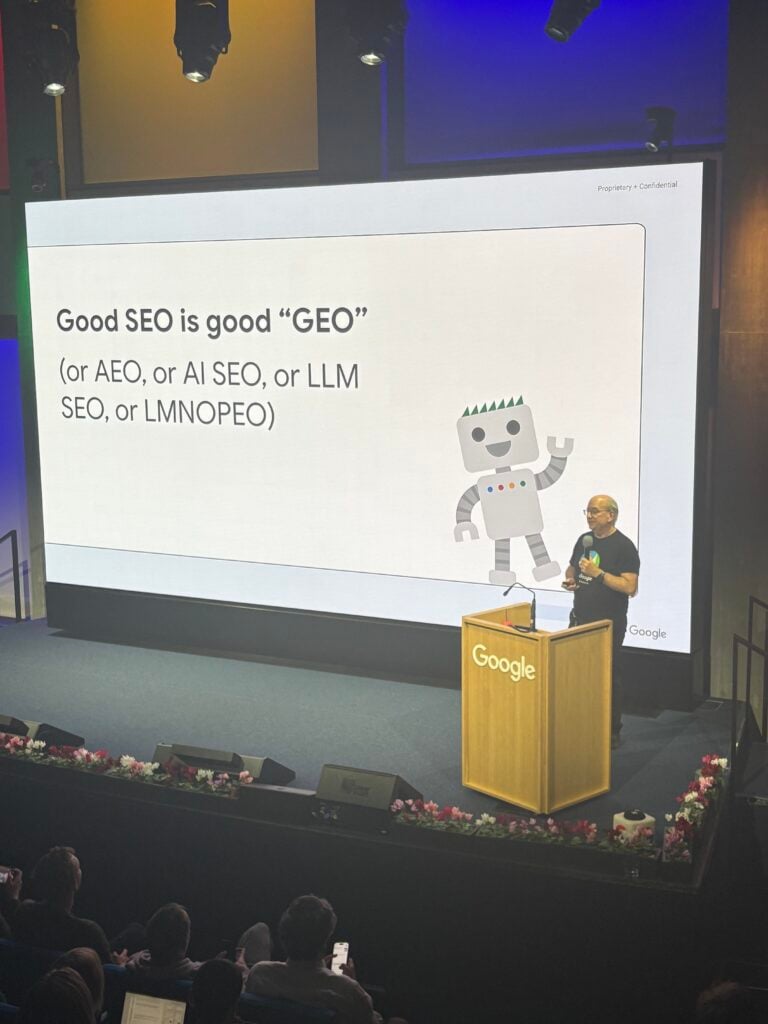
I’ve been rattling on about this for ages now (ie. Sitebulb blog “GEO vs SEO: The Emperor Has No New Tactics!”).
In our agency pitches prospects are presented with the below slide that explains our thinking as well and uses the iconic Mark Williams-Cook’s meme on the subject.
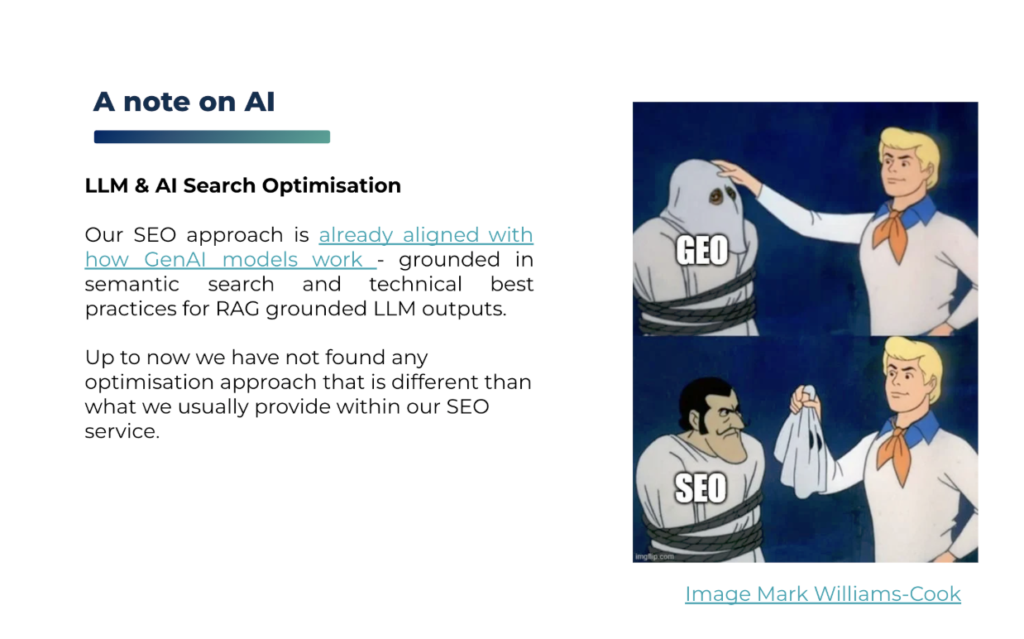
But, I’m beginning to see this is not enough unfortunately.
Sometimes doing the right thing costs you revenue and we have started to see this in our work here at Vixen as well.
John’s “GEO is just SEO” slide is in theory absolutely true, but in practice, it’s where agencies get squeezed. When the market is noisy and clients are being sold “AI SEO” as something fundamentally new, the honest answer (“this is still SEO”) can actually cost you revenue or even contracts.
We’ve lost work because we refused to pretend that AI search required an entirely separate service line.
This isn’t even just about snake-oil agencies creating confusion, it’s also about good agencies being pushed into rebranding the same work just to move projects forward.
At Search Central Live, I also heard a story to really bring this craziness with the shiny new thing into perspective. One well respected SEO had their SEO ticket stuck in devs backlog for months till he changed the reasoning to GEO instead of SEO. The ticket was picked up immediately!
Change one word and finally get sh*** done….Add one word and sign off enough retainer days to get the results….. Rebrand even if you know it’s the same thing and pay employees higher bonuses….
Or stick to your guns?
Tricky decision. I have no answers but it’s definitely something we are still thinking about here at Vixen and Search Central Live brought it right back to the surface.
Watch this space…
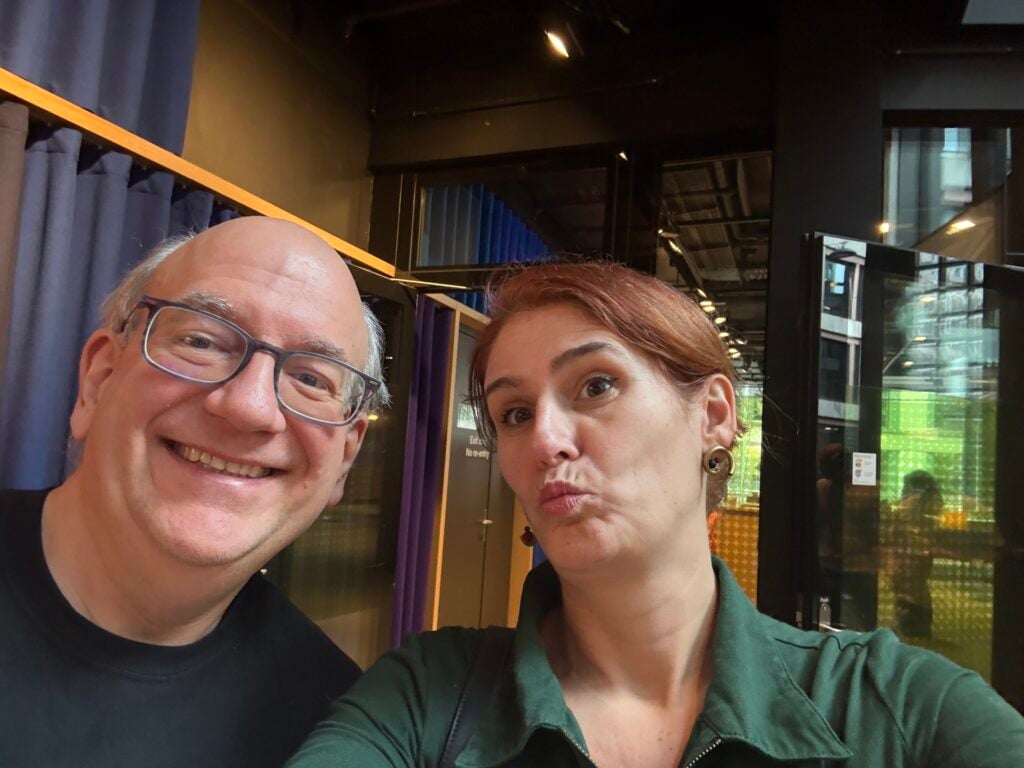
And, in the meantime, here’s me grabbing a quick selfie with John because even when we’re debating the future of SEO, GEO, AEO, or whatever acronym comes next, he’s still one of the people who genuinely cares about helping us navigate it.
Now moving on swiftly….
What didn’t get enough attention (But I wish it did)
To pull myself back from potential soppiness, here are a few gaps that stood out for me on the day:
AI search felt light-touch.
Considering how much speculation and interest there is in 2025 around AI and search, I expected more. A strategic roadmap, maybe predictive guidance. Instead, we didn’t get much. Which makes sense (it’s early days, after all), but I would’ve loved a little more direction.
Some sections of talks were too basic for a seasoned audience.
The room was full of experienced industry people so a few sessions felt a bit too entry level. It’s great to be reminded of all the brilliant documentation we have access to. But going too deep into the basics felt like a missed opportunity to cover other more advanced elements.
I appreciate that’s always a tricky balance when the audience is mixed, but it stood out to me. Particularly when the show of hands confirmed my suspicions on the audience profile!
No ETA on AI visibility in tools like GSC.
Now for the elephant in that and every other room we walk into: AI visibility. Everyone asked (loudly in the QA form and rather optimistically). The answer was the same: no news. No timelines. Just: we don’t know yet. Might be a wee frustrating but at least it’s honest.
In any case, personally, I have no idea how it would work and how useful it would be in the first place. There’s no reporting tool that can reliably tell you whether your content is being surfaced in LLMs, because the entire point of these systems is that results are personalised, ephemeral, and phrased differently every time.
At best, we’d get a sliver of directional insight and as more users adopt AI search, that sliver becomes even less representative.
So yes, it would be nice to have filters, dashboards, charts but the reality is that even if Google gave us something tomorrow, it would almost certainly be incomplete at best and misleading at worst.
First-party data is still our best friend. If traffic from AI-driven experiences grows, great. If not, there’s no chart in the world that will fix that.
In short, I’d love to get the tools in GSC but if I’m brutally honest I’m not convinced it would be genuinely useful. And judging by the collective shrug from Google yesterday, neither are they.
It all boils down to people!
One of the things I loved most about the day was obviously catching up with people I know and meeting new ones. The overall community vibe felt real. Especially satisfying was the strong presence of women in the community speaker line-up with folks like Dani Leitner, Crystal Carter, Corina Burri and Clara Soteras Acosta delivering clear, useful talks without fluff.
It reminded me yet again that the search world is more than rankings and traffic numbers, it’s people who care about building a better web.
I also arrived in Zurich a day earlier and a definite highlight was meeting up with a few like-minded industry professionals for fondue. Just a cosy intimate dinner for 20!

Final thoughts
If you’re knee-deep in jargon, log files, structured data debates, and AI predictions, take a moment to pause…. For those that are like me and struggle with the concept here’s a bit of help….try and let the horse*** fade away from time to time…
Massive shout of to Myriam Jessier for introducing me to a meditation I can actually stomach in their brilliant ADHD + SEO talk.
At the end of the day, no matter how much SEO rebrands itself, good search is good search. And, good people make good search.